Case Study
Stateful Trading Agent Sells AI Memory Stocks SNDK MU STX | Crash Alert
Historical case study — editorial context added 28 September 2026. Original claims and dates are preserved below. This is not a current signal or a representative performance result. The Stateful Trading Agent sold SanDisk (SNDK) at $2,340, Micron (MU) at $1,233 and Seagate (STX) at $1,100 before the coordinated memory-stock decline.
The Stateful Trading Agent sold SanDisk (SNDK) at $2,340, Micron (MU) at $1,233 and Seagate (STX) at $1,100 before the coordinated memory-stock decline.
Intuitive Code AI’s Stateful Trading Agent identified SanDisk, Micron and Seagate as a single correlated AI memory basket and issued coordinated sell signals across all three positions. The signals were published in real time through the free plan and on X before the subsequent declines confirmed the forecast. The complete record remains publicly timestamped and independently auditable.
Source insight: Stateful Trading Agent Signals Sell Memory Stocks: SNDK $2,340, MU $1,233, STX $1,100
← Back to Case StudiesExecutive Summary
Wall Street evaluated SanDisk (SNDK), Micron (MU) and Seagate (STX) as separate securities. The Stateful Trading Agent evaluated them as one correlated memory-stock basket and generated a coordinated basket exit rather than three disconnected ticker alerts.
The signals were published before the subsequent price declines. All three signals were timestamped through the free plan and public posts on X. Three signals. One coordinated decision. Three confirmations within days.
A stateless implementation without persistent position memory and portfolio context cannot reliably reproduce the same continuous basket-level decision process. This case study documents a portfolio-level decision architecture: one memory-sector cycle, three securities and one coordinated exit.
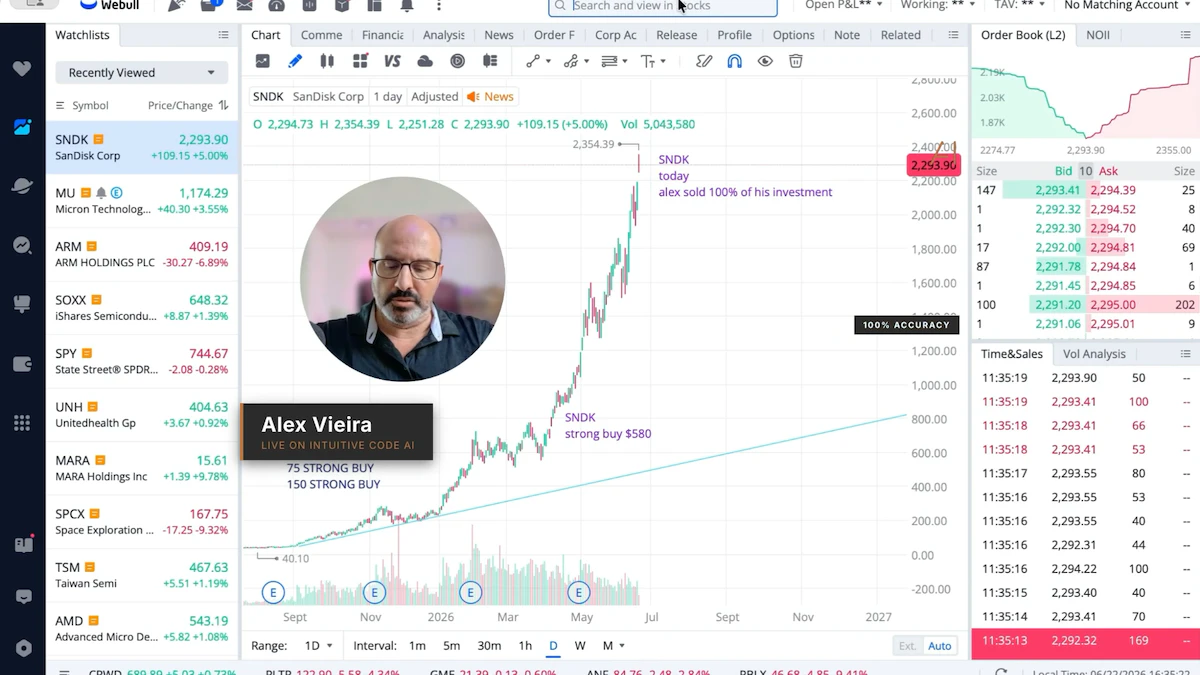
The Complete Memory Basket Cycle
SanDisk (SNDK)
- Signal: Sell
- Sell level: $2,340
- Subsequent reference price: approximately $1,700
- Approximate decline from sell level: 27.4%
- Wall Street targets near the signal date: approximately $3,000, subject to source verification
The sell signal was issued at $2,340 before the subsequent decline toward approximately $1,700. The calculation is ($2,340 − $1,700) ÷ $2,340 × 100 = 27.35%, rounded to approximately 27.4%.
The documented context is a divergence between the completed mesh exit and analyst targets that remained materially higher near the signal date. The approximately $3,000 target is presented as a source-dependent reference, not as an independently verified ranking or performance claim.
Micron (MU)
- Original accumulation level: approximately $67
- Sell level: $1,233
- Subsequent reference price: approximately $955
- Peak before decline: approximately $1,255
- Approximate decline from sell level: 22.5%
- Approximate decline from peak: 23.9%
- Previous target: $1,180
- Revised target date: June 25, 2026
The source record distinguishes the revised target from the later sell level. On June 25, 2026, the target was raised from $1,180 to $1,219. The subsequent public confirmation used the final sell level of $1,233. This case study therefore uses $1,233 for the sell signal and retains $1,219 as the prior revised target; it does not silently substitute one figure for the other.
From the sell level, ($1,233 − $955) ÷ $1,233 × 100 = 22.55%, rounded to approximately 22.5%. From the peak, ($1,255 − $955) ÷ $1,255 × 100 = 23.90%, rounded to approximately 23.9%.
Seagate (STX)
- Signal: Sell
- Sell level: $1,100
- Subsequent reference price: approximately $800
- Approximate decline: 27.3%
The $1,100 signal completed the coordinated memory-basket exit. The calculation is ($1,100 − $800) ÷ $1,100 × 100 = 27.27%, rounded to approximately 27.3%.
Signal Breakdown
| Asset | Ticker | Signal | Sell Level | Subsequent Reference | Approx. Move |
|---|---|---|---|---|---|
| SanDisk | SNDK | Sell | $2,340 | $1,700 | −27.4% |
| Micron | MU | Sell | $1,233 | $955 | −22.5% |
| Seagate | STX | Sell | $1,100 | $800 | −27.3% |
The table reports the signal levels and subsequent reference prices documented for this case study. It is a summary of historical evidence, not a projection or recommendation.
One Basket, Not Three Isolated Signals
The agent treated SanDisk, Micron and Seagate as one correlated memory complex: one thematic basket, multiple securities and one coordinated exit decision. The documented outcome is not presented as three unrelated ticker alerts.
The decision layer was evaluated in the context of persistent position history, prior accumulation levels, sector concentration, cross-asset correlation, capital rotation, cycle completion and portfolio-level exposure. These are the documented architectural concepts; this page does not claim access to proprietary inputs that are not publicly described.
Why the Stateful Architecture Matters
Stateless process
A stateless process evaluates the current request or current market snapshot without retaining durable position history or portfolio context between decisions. It can produce isolated signals, ticker-specific classifications and snapshot-based forecasts.
Stateful process
A stateful agent retains persistent context across time, including previous positions, prior signals, target revisions, basket membership, correlations, capital rotation decisions and exposure across the portfolio. That retained state allows it to treat the memory-stock complex as an evolving portfolio object rather than three unrelated tickers.
Stateless systems can generate signals. Stateful agents can maintain and complete trade cycles.
Persistent state is required for the specific continuous basket-level process documented here. That is a narrower architectural claim than asserting that basket decisions require stateful AI in every possible implementation.
One-to-Many Meshed Networking™
One-to-Many Meshed Networking™ describes an architecture in which one portfolio-level decision process can coordinate actions across multiple correlated assets. In this case, the memory complex is one thematic basket, multiple securities and one coordinated exit decision.
Read the framework in depth in the One-to-Many Meshed Networking™ AI Trading Masterclass. This page describes the documented portfolio-level behavior without disclosing or inventing proprietary implementation details.
Video Documentation
The video documents Alex Vieira presenting the SanDisk sell at $2,340, the broader coordinated memory-basket thesis, and the parallel SpaceX sell comparison at $229 followed by a reference price near $167.
The referenced SpaceX sell was followed by a decline from approximately $229 to approximately $167. The specific $229 sell signal preceded the documented decline; this case study does not make a blanket accuracy claim.
Video reference: Stateful AI coordinated memory-stock basket sell signals.
Methodology
Mathematical convergence
Signal generation is based on convergence across multiple quantitative conditions and evolving market state. This case study describes the observed decision sequence and does not invent formulas that are not part of the documented record.
Accumulation and distribution
Accumulation identifies favorable asymmetric entry conditions. Expansion tracks sustained appreciation. Acceleration identifies late-cycle price expansion. Distribution identifies completed upside objectives and declining reward relative to risk. Capital rotation reallocates exposure after the cycle completes.
Accumulation → Expansion → Acceleration → Distribution → Capital Rotation
SNDK, MU and STX were evaluated as a shared memory-sector cycle. The sequence explains how the documented process can move from initial accumulation through appreciation and distribution to a coordinated capital-rotation decision.
Public Verification and Independent Audit
- Signals published on the free plan
- Signals published publicly on X
- Video timestamp
- Source insight publication date: July 4, 2026
- Historical market prices
- Product records where available
The signals were published before the subsequent price action. The record is independently auditable. Readers can compare the source insight, publication timestamps, product records where available, recorded video and historical prices without treating this page as a third-party audit.
Related Reading
- View the complete SanDisk stateful trade-cycle case study
- Complete memory-stock insight
- One-to-Many Meshed Networking™ masterclass
- AI Trading Signals Expert
- Stateful Decision Intelligence
- Personal AI Trading Agents
- Case Studies
- Videos
- Forecasts
- Insights
- Products
- Autonomous Trading login
Disclaimer
This material is provided solely for educational and informational purposes and does not constitute investment advice, an offer, or a recommendation to buy or sell any security.
The documented historical signals do not guarantee future performance. Trading involves substantial risk, and past performance does not indicate future results.
Readers should perform independent research and assess their own risk tolerance before making any financial decision.